
The clip opens on familiar turf for fans of the long-running variety hit, the cobblestone avenues of Kanawha Falls. This is the fictional hamlet that hosts “As the Stomach Turns,” the show-within-a-show soap parody that has anchored the program for years.
Today’s episode, drawn from the seventh season, plunges viewers straight into the chaos of Marion’s small-town weekend. Our frazzled heroine stands at the heart of the storm, hands already fluttering with worry.
She confides to a neighbor that her mysteriously orphaned niece Raven is arriving by bus from Washington, D.C. Marion gushes that Raven is “a sweet innocent little girl” who will “never give me a moment of worry.” The line lands like a dare, a perfect setup for the mayhem about to unfold.
The doorbell rings, and in sweeps Raven, played by Bernadette Peters with a radiant, almost suspiciously wholesome smile. She bears gifts from the capital, including cherry blossoms and a box of Martha Washington candy.
She sings a sunny greeting that sounds sweet on the surface but somehow carries an odd chill underneath. Before Marion can protest, Raven “accidentally” crushes the vase of flowers in her arms.
“Oh dear,” Raven chirps, in a voice pitched just a touch too high. “I’m so sorry, Grandmother.” The word lands hard, since Marion has not once introduced herself as anyone’s grandmother.
The vase lies in shards at her feet, and the parlor suddenly feels colder than the drafty room should allow. Marion clutches her pearls and stares at her visitor with growing unease.
Raven next plucks the candy box from her bag and tosses it casually into the dirt outside the door. She announces that the room is freezing, even though she herself admits she does not feel any chill.
Marion shuffles toward the kitchen, already sensing trouble brewing beneath her niece’s perfect posture. The audience can feel the sketch tilting toward darker territory.
The mood shifts when Raven stares down at Marion’s swollen wrist and calmly predicts a flare-up of bursitis. The diagnosis is delivered with eerie precision, as if she had somehow read the script of Marion’s medical chart.
Then her smile slips, and something darker flickers behind her eyes. A long, theatrical pause stretches across the parlor.
Suddenly, Raven’s voice drops an octave, and her head begins to rotate in an unmistakable horror-film tribute. She announces, in a guttural growl, that she is “possessed” and demands to be called “Grandmother” again.
Marion screams, clutches a chair, and dials the only number she can think of in her panic. The comedic pivot from soap to supernatural has landed with full force.
“Auto Black Flag, Canawha Falls’ leading exterminator,” Marion blurts into the receiver, her voice quavering with fear. “Please hurry.
I have a situation.” The operator on the other end apparently takes such calls in stride, because a knock arrives within seconds at the parlor door. Marion hangs up and braces herself for whatever is about to walk through.
The door opens to reveal a shaggy, wild-haired opportunist in a rumpled coat. He introduces himself as a freelance exorcist, a career pivot he made after a horror film caught on at the local movie theater.
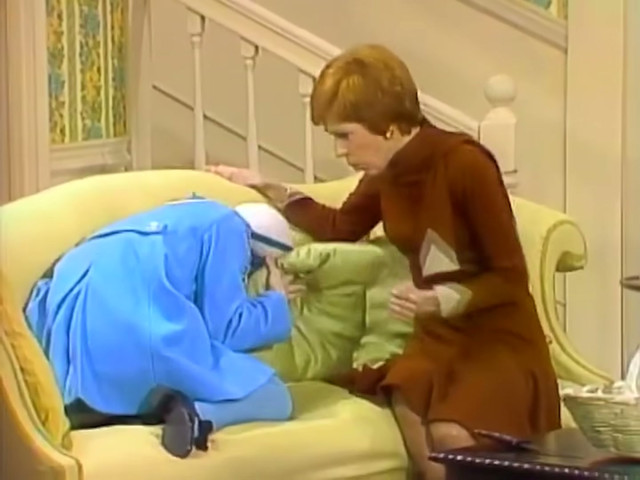
Pest control, he explains with a shrug, just wasn’t paying the bills anymore. So he rebranded on the fly and never looked back.
The self-styled wizard leans casually against the doorframe, brandishing a tattered spell book. He sizes up Raven, who by now is levitating slightly off the floor and making theatrical hand gestures.
“A routine possession,” he assures Marion with practiced calm, “well within my wheelhouse.” Marion relaxes, just a fraction, at his confident tone. He then launches into a boastful résumé, recounting a previous case in Chicago.
He blames that incident on the June Taylor Dancers, whose rhythmic tapping allegedly summoned the wrong spirits. He taps his own fingers against the spell book as he speaks, illustrating the curse with broad comedic gestures.
Marion nods politely, not understanding a single word. Raven, unimpressed by the newcomer, lets out a low demonic chuckle and declares he has “no powers over me.” The exorcist flips through his book, pretending to search for the correct Latin phrase.
Marion wrings her hands and urges him to hurry, calling him “old mighty wizard” in her flustered distress. The audience howls at her polite desperation.
The exorcist insists, in a deeply earnest tone, that evil can only be defeated through “goodness and purity.” He asks Marion to fetch a candelabra and a bowl of spring water, both standard ritual items in his improvised trade. Marion dashes off, leaving Raven to taunt the wizard alone for a brief moment.
Raven grins a grin that does not reach her eyes. The wizard plants his feet and squares his shoulders, channeling what he calls his “purity reserves.” He begins a long incantation that sounds suspiciously like a recipe for tapioca pudding.
Raven rolls her eyes, or at least her head does, in a slow theatrical circle that draws gasps from the offstage audience. The laughs keep coming in waves.
Marion returns with the candelabra just as the wizard’s voice rises to a theatrical crescendo. She places the bowl of water on the parlor table and lights the candles with trembling hands.
The three characters freeze in tableau as the wizard prepares to unleash his grand ritual. The audience leans forward in anticipation.
The clip ends on a deliberate cliffhanger, just before the exorcist completes his spell. Raven cackles one last demonic warning, and Marion clasps her hands in prayer.
The wizard raises the spell book high, and the scene cuts to black with the audience left howling in laughter at the absurd spectacle. The sketch earns its applause in full.
Throughout the bit, the comedy thrives on contrast. Marion’s 1950s-style decorum, with its polite small talk and genteel pearls, sets up every supernatural gag perfectly.
Bernadette Peters delivers Raven’s transformation with a brilliant shift from perky innocence to theatrical menace, never overplaying the demonic beats. The whole sequence lands as affectionate parody.
The exorcist, meanwhile, plays the perfect comic foil to both women, treating his profession with mock solemnity. His improvised backstory, the June Taylor Dancers, and his tapioca-pudding incantation all land as gentle jabs at horror film conventions.

The show’s signature blend of sentimental warmth and broad physical comedy is on full display for the entire runtime. Even by the standards of a variety show famous for stretching its sketches into operatic chaos, this clip pushes the parody to wild extremes.
The creators trust their audience to follow the laughs from sunny soap to spooky possession without missing a beat. The result is a perfectly paced slice of television history that still plays well decades later.
For fans revisiting the episode, the segment remains a highlight of the show’s seventh-season run. It showcases Bernadette Peters’ gift for shifting between sweet and sinister in a single scene.
It also reminds viewers why “As the Stomach Turns” became one of the most beloved recurring bits on the program. The chemistry on screen is undeniable.
The Carol Burnett Show built its legacy on sketches that mixed warmth with wildness, sentiment with slapstick. This particular clip captures that balance with grace, finding laughs in both the cozy parlor and the supernatural chaos.
It is the kind of television moment that rewards rewatching, revealing new comic beats on every viewing. New fans continue to discover it online.
The producers clearly relished the chance to spoof the horror genre that was booming at the time. They dressed the parlor in cheerful curtains and lace doilies, then staged the supernatural chaos against that wholesome backdrop.
The clash of tones is exactly what made the program a cultural touchstone. It is parody done with affection rather than contempt.
Bernadette Peters, then a rising star, used the role to display remarkable range within minutes of screen time. She could pivot from sweet niece to guttural villain without breaking the comic spell.
Her timing, her arched eyebrow, her slow head turn all land as expert physical comedy. The sketch offered her a perfect showcase for her gifts.
The supporting cast, including the frazzled heroine and the rumpled exorcist, anchor the mayhem with seasoned timing. They allow the bigger comic moments to breathe while keeping the soap-opera framing intact.
By the end, the audience has laughed at voodoo, vaudeville, and visit-from-the-capital all in one tight scene. That balance is no small feat.
For longtime viewers, the clip also serves as a time capsule of late-1970s television. The fashions, the decor, the references to Martha Washington candy and the June Taylor Dancers all place it firmly in its era.
Yet the comedy itself feels timeless, which explains its continued popularity online. Good parody, it turns out, ages far better than most.
Ultimately, the sketch earns its place in the show’s catalog through sheer comic discipline. Every gag is set up by the previous one, and every payoff lands where it should.
The cliffhanger ending, with the wizard mid-spell and Raven mid-cackle, leaves viewers delighted and wanting more. It is variety television operating at the very top of its game.
Để lại một bình luận