For decades, Western movies were treated like one of America’s most powerful exports.
The dusty streets.
The dangerous saloons.
The fearless marshals.
The lonely gunfighters.
The tense card games.
The final showdown under a burning frontier sky.
Audiences around the world knew the formula, and many of them loved it.
So when The Carol Burnett Show decided to imagine what an American Western might look like if it were made in Germany, the result was not just a spoof.
It was a full comedy ambush.
The sketch opens with the familiar idea that Westerns had become popular far beyond the United States.
Classic shows like Gunsmoke and Bonanza had already turned cowboys into international icons.
But then comes the twist.
What if European studios did not just watch Westerns.
What if they tried to make their own.
That one question becomes the doorway into a bizarre saloon world where the Wild West suddenly feels like it has been rebuilt through a German studio’s wild imagination.
The fictional production is introduced with great seriousness, as if the audience is about to witness a grand international film event.
Instead, they are dropped straight into a parody called Heil Chapparel, filmed in the “Wild West” but filtered through exaggerated accents, strange rhythms, and the kind of ridiculous cultural collision only classic variety television could pull off.
The first major eruption comes inside the saloon.
The atmosphere looks familiar at first.
There are cowboys.
There is music.
There is a stage.
There is a singer presented like the great songbird of the frontier.
But from the moment Kitty Marlin steps forward, it becomes clear this is not going to be a normal Western performance.
She greets the room with theatrical confidence and launches into a saloon number that feels both glamorous and completely unhinged.
The song keeps circling around the boys in the back room, the drinks they might want, and the strange emotional logic of a Western saloon where everyone appears to be one wrong note away from disaster.
The joke works because the show treats the performance as if it belongs in a serious cowboy film.
That makes the absurdity even sharper.
Instead of a romantic frontier ballad, the saloon gets a strange, overdone musical moment that turns the room into a comedy pressure cooker.
Then the real danger walks in.
Marshal Dylan enters with authority, suspicion, and a threat that immediately flips the sketch from musical parody into gunfighter chaos.
He warns the crowd that one wrong move could leave them full of holes.
The line is dramatic.
The delivery is ridiculous.
That contrast is exactly where the sketch finds its power.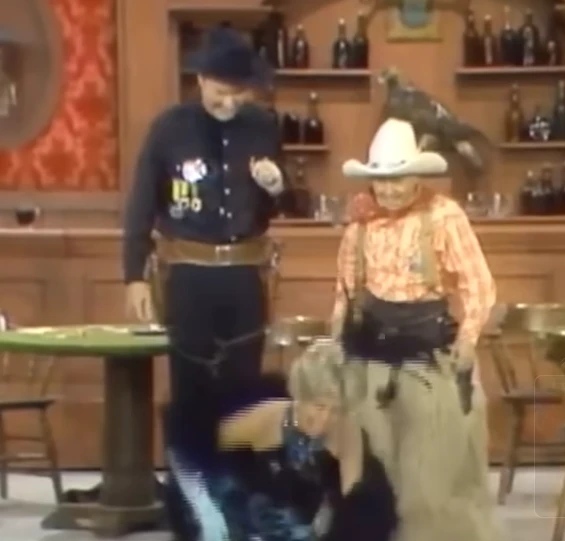
The marshal believes he is terrifying.
The audience knows he is trapped inside a comedy machine that will destroy his dignity piece by piece.
His first target is the card game.
Rumors have reached him that the saloon may be running crooked cards.
In a normal Western, this would be the beginning of a deadly confrontation.
Here, it becomes a ridiculous argument about honesty, cheating, and masculine pride.
The card player insists he runs a fair game.
The marshal warns him that one act of cheating will shut the place down.
Then the cards betray the whole room almost instantly.
Three aces turn into four aces.
The supposedly honest game suddenly looks suspicious in th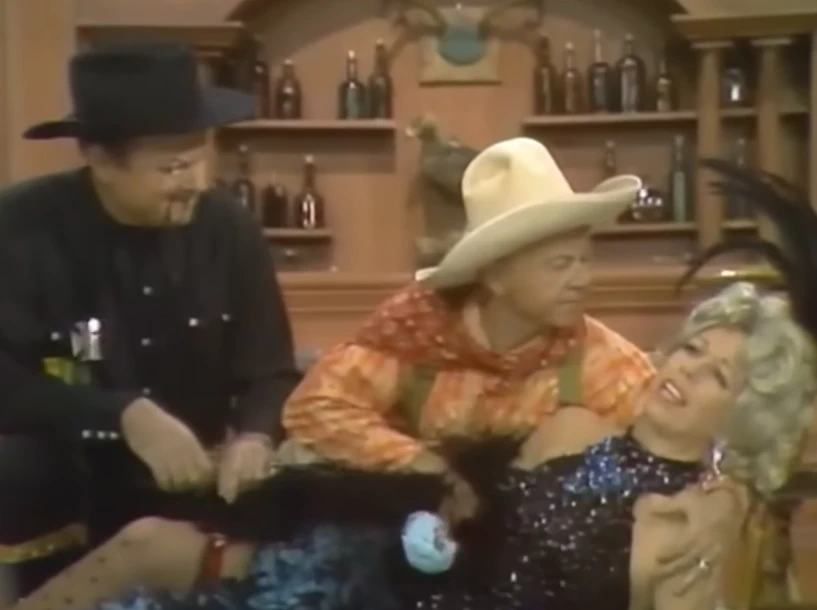 e most obvious way possible.
Instead of exploding into violence, the moment slides into farce.
The saloon owner tries to smooth everything over with a drink.
That drink becomes the marshal’s undoing.
The joke of the schnapps “on the house” is simple, physical, and brutally effective.
The marshal thinks he is being offered free liquor.
But the gag twists the phrase literally.
Again and again, the drink ends up on top of the house instead of in his throat.
The more he asks, the worse it gets.
The marshal wants to keep control of the room.
Instead, he is slowly turned into a victim of his own misunderstanding.
By the time he complains that he may have fractured his skull, the Western authority figure has been completely dismantled.
He is no longer the fearless protector of the town.
He is a grouchy, aching man with a terrible headache and a saloon full of people watching him unravel.
That is when the sketch raises the stakes again.
The name Wilhelm the Kid enters the scene.
At first, the marshal tries to act unimpressed.
The name means nothing to him.
Then he learns the outlaw is coming to kill him.
Suddenly, the name means quite a lot.
It is a perfect comedy reversal.
The marshal’s bravery lasts only as long as the danger remains theoretical.
The second death becomes personal, his confidence begins to wobble.
Wilhelm the Kid arrives like a parody of every legendary outlaw who ever walked through swinging saloon doors.
He is searching for the marshal.
He announces himself with stiff menace.
He wants a showdown.
The room braces for violence.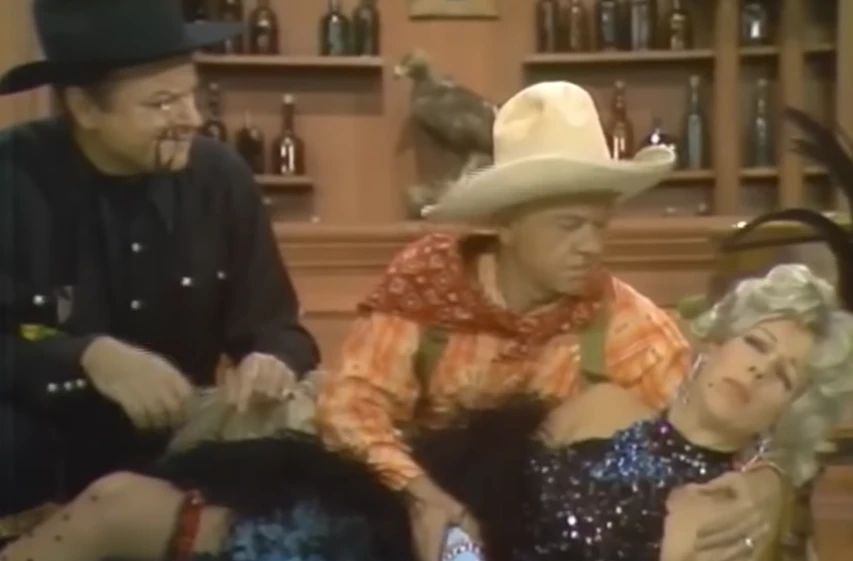
The audience braces for nonsense.
The confrontation turns into a “shoot-off,” repeated with escalating silliness until the phrase itself becomes part of the joke.
The scene knows exactly what it is mocking.
Western showdowns are supposed to be clean, tense, and iconic.
Two men face each other.
The room goes silent.
Hands hover near guns.
One shot decides everything.
But here, even the rules of the showdown feel broken.
The gunfight becomes confused, clumsy, and strangely musical.
The danger is real only inside the characters’ minds.
For everyone watching, the entire moment is an expertly controlled collapse.
Then comes the final absurdity.
Someone is hit.
Someone starts dying.
But even death cannot be allowed to happen normally in this world.
Before the end, the dying character wants to go out with a song on the lips.
That request brings the saloon singer back into the center of the chaos.
A dramatic death scene becomes another musical gag.
The melody returns.
The emotions are exaggerated.
The timing grows stranger.
The character fades away while the song keeps dragging the scene into deeper ridiculousness.
It is not a heroic death.
It is not a tragic farewell.
It is the kind of ending only The Carol Burnett Show could build, where every familiar movie cliché is pushed just far enough to collapse in front of the audience.
What makes this sketch so memorable is not just the accent comedy or the Western parody.
It is the speed at which the entire world loses control.
The saloon starts as a recognizable cowboy setting.
Then it becomes a nightclub.
Then it becomes a gambling den.
Then it becomes a battlefield.
Then it becomes a funeral with music.
Every few seconds, the sketch changes shape.
Every familiar Western convention gets twisted.
The tough marshal becomes ridiculous.
The honest card game becomes suspicious.
The deadly outlaw becomes theatrical.
The final shootout becomes a chant.
The death scene becomes a song cue.
That is why this parody still works as a piece of classic comedy.
It understands that Westerns are built on ritual.
The entrance.
The threat.
The drink.
The card game.
The outlaw.
The duel.
The death.
Then it breaks every ritual in the funniest way possible.
By the end, the audience is not watching a Western anymore.
They are watching the Wild West fall apart under the weight of its own clichés.
And somehow, through all the chaos, the sketch turns one simple question into a perfect comedy disaster.
What would a cowboy movie look like if Germany made it.
According to The Carol Burnett Show, it would have schnapps, singing, cheating, headaches, gunfire, and one final death scene that refuses to die quietly.
Để lại một bình luận