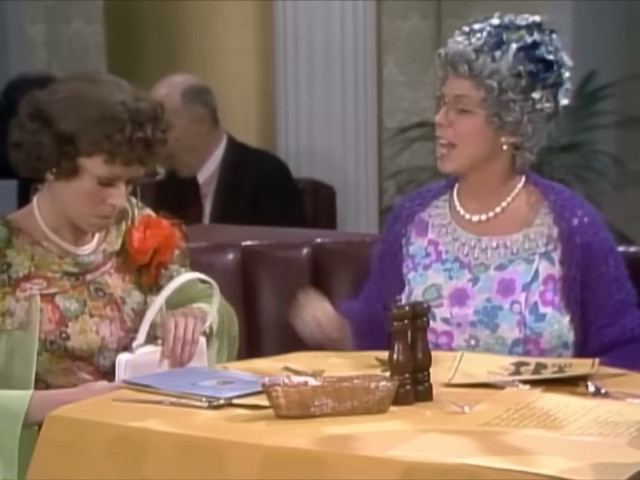
The Higgins family reaches the elegant restaurant with a complimentary pass, aching feet, and an argument already in full swing. Before anyone studies the menu, the evening feels one complaint away from disaster.
Eunice is furious because Ed refused to pay for convenient parking, forcing everyone to walk roughly half a mile. Mama repeats that her feet hurt, transforming every remaining step into a fresh family grievance.
That exhausted entrance gives the sketch its sharp comic premise. The family has gained access to luxury, but they arrive carrying every resentment, insecurity, and penny-pinching habit they possess.
Inside, the surroundings could hardly be more polished. Chandeliers glitter overhead, thick carpet cushions the floor, and formal service promises an experience far removed from the family’s ordinary routine.
Mama studies the décor with open amazement, responding to the restaurant almost like a visitor touring a grand landmark. Ed remains far less impressed, especially whenever elegance appears connected to higher prices.
Eunice immediately understands the social stakes. She wants her family to blend into the refined setting, but their exhaustion and bluntness make that ambition nearly impossible.
Carol Burnett plays Eunice as a woman determined to manufacture sophistication through sheer force of will. Her extravagant politeness toward the host reveals both excitement and deep anxiety about being judged.
Every enthusiastic thank-you is also a warning aimed at her family. She smiles for the staff, then turns toward her relatives with the tense vigilance of someone expecting an embarrassing eruption.
Ed delivers that eruption almost immediately by announcing the complimentary pass. What Eunice hoped would remain a quiet advantage becomes public information, loudly confirming that they did not choose this expensive restaurant freely.
The pass had been distributed to mall merchants, giving the family a rare chance to experience upscale dining without paying the usual price. Ed treats that fact as practical information rather than a secret.
For Eunice, however, the announcement shatters the image she has been trying to create. She wants to look comfortable among the chandeliers, not like someone clutching an admission ticket.
Seating brings another round of friction. Mama’s aching feet make comfort urgent, while Eunice keeps trying to impose order and prevent the family from turning a simple table assignment into open conflict.
The comedy grows because no concern stays small. A chair becomes a territorial dispute, ordering priority becomes a moral question, and ordinary restaurant customs become obstacles requiring lengthy family negotiations.
Eunice repeatedly invokes common courtesy, hoping those words will restore control. Instead, her corrections become increasingly frantic, exposing that she is just as combustible as the relatives she scolds.
Ed’s attention soon lands on the menu prices. His loud disbelief punctures the restaurant’s calm atmosphere and makes the family’s financial discomfort impossible for nearby diners to ignore.
He does not quietly calculate or disguise his concern. He reacts with the blunt alarm of someone who believes every printed price deserves immediate public examination.
Eunice can feel her carefully staged evening slipping away. The more forcefully she tries to silence Ed, the more attention their table appears likely to attract.
His decision to order a beer adds another clash between expectation and instinct. Eunice wants polished behavior, while Ed sees no reason to abandon familiar preferences merely because the carpet is thicker.
Cocktails create more uncertainty rather than relaxation. The family debates what should be ordered, who understands the choices, and whether unfamiliar drinks are worth the trouble or expense.
Each question exposes another layer of unease. Fine dining promises pleasure, but the Higgins family experiences it as a test filled with hidden rules and expensive consequences.

Mama, meanwhile, discovers a different way to benefit from the restaurant. She begins pocketing sugar, treating the table’s supply as something too useful to leave behind.
Eunice reacts with horror because the small act threatens her entire performance of respectability. Mama sees thrift, while Eunice sees evidence being transferred directly into a purse.
That disagreement captures the family’s competing values. Eunice craves approval from strangers, Mama refuses to waste anything, and Ed distrusts an establishment where dinner appears priced like an investment.
Their bickering also reveals old tensions beneath the evening’s surface. Ed resents Mama’s presence, while Eunice remains trapped between defending her mother and regretting every disruptive choice.
The restaurant therefore becomes more than a lavish backdrop. It acts like a spotlight, enlarging every private irritation until the family’s familiar quarrels become a public spectacle.
Mama’s trip to the restroom offers no escape from the escalating trouble. She returns irritated after encountering an attendant who apparently expects a tip for providing assistance.
To Mama, the expectation represents another unnecessary charge hidden inside an already expensive experience. Her indignation arrives at the table with enough force to interrupt whatever fragile calm remained.
Eunice receives the complaint as another social catastrophe. She knows tipping is part of the environment, but explaining that custom only creates another argument about money and principle.
The joke never depends solely on the family lacking knowledge. It comes from their absolute confidence that unfamiliar customs should be challenged, debated, and possibly rejected in front of everyone.
That confidence collides with Eunice’s desperate need to appear informed. She may understand more etiquette than Ed and Mama, but her mounting frustration makes graceful behavior increasingly difficult.
Burnett’s performance turns that contradiction into the scene’s emotional engine. Eunice tries to police every voice, gesture, and decision, yet her own temper produces the loudest disruptions.
The family’s discomfort reaches another level when the waiter introduces the salad bar. His courteous invitation to “visit” it sounds simple, but the wording immediately opens the door to confusion.
The family treats “visit” almost literally, as though the salad bar were a person requiring conversation. A routine dining instruction suddenly becomes a puzzle nobody seems eager to solve.
Standing presents another problem because Mama’s feet still hurt from the long walk. The free dinner has already demanded more physical effort than she considers reasonable.
Instead of rising and moving smoothly, the family debates who should go first. Their uncertainty transforms a short walk across the dining room into a ceremonial procession without an agreed leader.
Eunice again attempts to direct traffic. She wants everyone moving with quiet confidence, but every instruction generates another complaint, correction, or stubborn pause.
At the salad bar, unfamiliar utensils become the next comic obstacle. Serving food should be straightforward, yet the family approaches the equipment with suspicion and visible confusion.
The physical comedy works because the setting demands restraint. Every clumsy movement appears larger against the restaurant’s controlled atmosphere, where diners are expected to understand the procedure without discussion.
Mama’s reluctance, Ed’s impatience, and Eunice’s embarrassment converge around bowls and serving tools. The family is no longer merely ordering dinner; they are battling the machinery of refinement.
Audience laughter rises from the contrast between appearances and behavior. The restaurant remains serene, but the Higgins family carries its own weather system of complaints, accusations, and wounded pride.

Their complimentary meal was supposed to be a treat. Instead, each luxury becomes another opportunity to feel uncomfortable, spend money, break a rule, or argue about who caused the problem.
Ed’s refusal to pay for parking now feels like the first domino. That small act produced the long walk, the aching feet, the bad mood, and the resentment following them indoors.
Mama’s repeated complaints keep that decision alive throughout the meal. Every time she must stand, move, or navigate another custom, the distant parking space returns as evidence against Ed.
Eunice cannot let the evening collapse because the restaurant represents something larger to her. It offers a brief chance to feel glamorous, worldly, and removed from ordinary family frustration.
That dream makes every embarrassment hurt more. She is not merely correcting manners; she is fighting to preserve the evening she imagined before the family entered the room.
Yet her relatives refuse to become supporting players in that fantasy. Ed remains blunt, Mama remains stubborn, and both respond to Eunice’s pressure by digging deeper into their positions.
The sketch’s brilliance lies in how naturally the conflict escalates. No single mistake ruins dinner, but dozens of tiny collisions steadily turn privilege into punishment.
A free pass leads to parking complaints. Parking complaints lead to aching feet, aching feet complicate seating, seating invites arguments, and the menu triggers a fresh crisis over cost.
Sugar disappears, cocktails cause confusion, and a restroom visit produces outrage over tipping. By the time the salad bar appears, the family is primed to treat lettuce like an adversary.
The refined staff provides a calm counterweight to the turmoil. Their professional language and measured service make the family’s reactions seem even louder, sharper, and more gloriously out of place.
Nobody needs to announce that the evening has gone wrong. Eunice’s tightening patience, Ed’s price protests, and Mama’s running commentary make the collapse visible in every exchange.
Still, the scene never loses its affectionate recognition of family behavior. These people know exactly how to irritate one another because they have been repeating the same arguments for years.
Their conflict feels immediate, but it also feels inherited. The restaurant merely supplies new objects for familiar disagreements about money, manners, loyalty, inconvenience, and respect.
That familiarity allows the performers to build laughs through timing rather than elaborate plot twists. A pause, a repeated complaint, or a badly timed correction can detonate the entire table.
Burnett anchors the chaos by making Eunice’s humiliation both enormous and understandable. Her desire for one elegant evening may be unrealistic, but it is never difficult to recognize.
The harder she chases refinement, the farther it retreats. Every attempt to control her family becomes another public scene, leaving her trapped between social ambition and emotional exhaustion.
By the salad bar sequence, the family has turned fine dining into an endurance test. They have survived the walk, the prices, the seating, the sugar, the cocktails, and the tipping dispute.
What remains is the spectacle of people confronting unfamiliar etiquette while refusing to surrender their habits. The complimentary dinner costs them nothing, yet extracts patience from everyone at the table.
That reversal gives the sketch its lasting comic sting. The family wins access to an elegant restaurant, but luxury cannot soften their bickering or make their aching feet hurt less.
Instead, the chandeliers illuminate every insecurity, the thick carpet carries every complaint, and the formal service frames their disorder perfectly. Their free night out becomes priceless comedy precisely because nobody can relax.
Để lại một bình luận