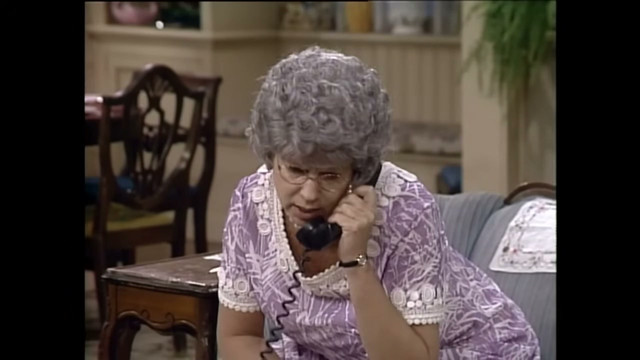
For three years, the monthly electric bill has arrived with the comforting precision of a household ritual: exactly $50.59. Then one envelope lands with a demand for $70.59, and Mama refuses to surrender quietly.
That unexplained $20 increase becomes an insult, a mystery, and eventually a full-scale domestic emergency. What begins as a customer-service complaint soon threatens schoolwork, grooming plans, clean clothes, and an important awards banquet.
Mama plants herself beside the telephone, armed with certainty and an account number she can recite without hesitation. She has studied the bill so intensely that every digit seems permanently stamped into her memory.
The first call tests her patience before she can even reach a person capable of answering questions. Hold music, transfers, and repeated requests for information transform a routine inquiry into an exhausting battle of wills.
Each new representative seems to send her back to the beginning. Mama repeats the account number, explains the increase, and insists that her household has done nothing to justify another $20.
Her frustration sharpens with every delay. The company may control the wires, meters, and monthly statements, but Mama believes stubbornness remains the strongest force operating inside this house.
She has a compelling piece of evidence on her side. A bill that remains unchanged for three years does not suddenly leap without a reason, especially when she claims electricity use stayed steady.
Yet the activity surrounding her quietly challenges that argument. While Mama describes a modest, predictable household, nearly every available appliance appears to be humming, heating, spinning, or flashing nearby.
Bubba is working on a school paper with electronic equipment, trusting the household current to preserve his progress. His concentration depends on technology that feels reliable until the exact moment it is not.
Elsewhere, Naomi and Vint are racing against the clock before an awards banquet. Their preparations require showers, freshly dried clothing, an iron, electric rollers, bright lights, and uninterrupted power.
The contrast gives the sequence its comic spark. Mama insists nobody is using more electricity while the house practically performs a noisy demonstration of modern electrical dependence behind her.
Laundry equipment turns, water heats, grooming devices warm, and schoolwork advances one electronic step at a time. Nobody notices the contradiction because everyone is focused on a separate deadline.
For Mama, however, the dispute has become about principle rather than money. Twenty dollars matters, but being treated as though her questions are unreasonable matters even more.
She has been a customer for more than half a century, and she believes that history should command respect. Surely the utility will not challenge someone whose payments stretch across generations of service.
That confidence hardens into refusal. Mama announces that she will not pay a bill she believes is wrong, expecting the company to investigate before taking any drastic action.
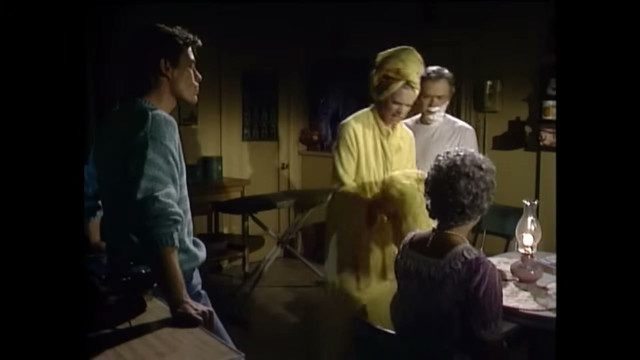
The response arrives with brutal comic timing. Almost immediately after her declaration, the lights vanish, appliances stop, and the entire household drops into darkness.
The silence after the shutdown is almost as dramatic as the blackout itself. Machines that had filled the rooms with purposeful noise become useless objects in a single instant.

Bubba’s school paper suffers the most immediate academic blow. His work disappears with the power, turning hours of effort into another casualty of Mama’s stand against the utility.
His reaction carries real exasperation beneath the comedy. A billing argument that seemed distant and administrative has suddenly entered his life, erased progress, and placed his assignment in jeopardy.
Naomi faces a different disaster, although it feels equally urgent to her. Her dress remains wrinkled, her hair is unfinished, and the banquet clock continues moving without mercy.
The outage traps her midway between preparation and presentation. Every tool she expected to use has failed at once, leaving her to imagine arriving at the event visibly unready.
Vint is caught in the same collapsing schedule. Shower plans, clothing preparations, and the couple’s carefully timed departure are thrown into confusion by one stubborn unpaid bill.
The family initially searches for an explanation that does not point toward Mama. A neighborhood outage would be inconvenient, but at least it would make the disaster nobody’s fault.
Mama eagerly embraces that possibility. Random equipment trouble, a wider service interruption, or some distant failure all sound preferable to admitting that her refusal triggered the darkness.
Then the outside world betrays her defense. Lights remain visible on another street, glowing with infuriating normality while her own household stands powerless.
That small patch of illumination becomes decisive evidence. The problem is not universal, and it is not mysterious; this particular home has been disconnected.
The family’s attention swings toward Mama. Their anger gathers quickly because each person can now identify exactly what her decision has cost.
Bubba has lost work, Naomi has lost preparation time, and Vint has lost any confidence in their schedule. Mama’s private dispute has become a shared crisis with multiple furious witnesses.
Cornered, she finally admits responsibility. Even then, she protects herself with humor, suggesting that retreat may be wise before the family finds a way to answer her stubbornness.
Her quick escape releases some of the pressure without resolving the practical problem. The house remains dark, the banquet remains imminent, and the school paper remains compromised.
Then, just as suddenly, the electricity returns. Lights flare, appliances awaken, and the family greets ordinary household power like a long-awaited rescue.
The celebration is immediate and wonderfully excessive. After only a short outage, functioning electricity feels less like a monthly service and more like a miracle delivered through the walls.
Relief changes everyone’s priorities. Schoolwork can resume, banquet preparations can restart, and even the possibility of waffles enters the conversation as proof that normal life has returned.
For a brief moment, Mama’s gamble appears successful. She resisted the bill, endured the family’s outrage, and still watches the house come back to life.
The real victory arrives through confirmation from the utility. Mama was right about the original charge, and the company acknowledges that the account was overbilled by exactly $20.
That finding should be her moment of complete vindication. After repeated questions and endless waiting, the supposedly difficult customer has proved more accurate than the company’s own statement.
The corrected charge validates every suspicious glance she gave the bill. It also justifies her insistence that three years of identical payments meant something important.
However, the utility has one more figure waiting. Restoring service carries a $50 reconnection fee, transforming a $20 correction into a considerably more expensive lesson.
The arithmetic is devastatingly simple. Mama wins the argument, recovers the disputed amount, and still emerges $30 behind because her victory required the power to be reconnected.
That final twist captures the episode’s sharpest joke. Correctness offers no protection from consequences when pride, bureaucracy, and bad timing collide inside one crowded household.
Mama’s satisfaction evaporates instantly. The woman who spent the day demanding recognition for a $20 mistake now faces a larger charge created by her refusal to compromise.
Her fury returns with renewed force because the company has managed to concede defeat while still collecting more money. It is the kind of institutional logic designed to ignite her temper.
Rather than accept the fee, Mama prepares for another confrontation. This time, a telephone call is no longer enough, and she intends to challenge the utility face to face.
The closing beat sends her storming toward that next battle, still convinced that persistence can overpower policy. Whether the company is prepared for her arrival becomes the final delicious question.
The sequence works because every complication grows naturally from the first disputed number. Twenty dollars creates a phone marathon, the marathon inspires defiance, and defiance shuts down an entire family’s plans.
It also exposes how fragile household order can become when electricity disappears. School assignments, personal routines, clean clothing, hot food, and social obligations all depend on an invisible current.
Mama understands the value of that current only after withholding payment makes it vanish. Yet even the blackout cannot persuade her that an incorrect bill deserves unquestioned obedience.
Her position remains both reasonable and reckless. She correctly identifies the mistake, but her refusal to consider the immediate consequences forces everyone else to absorb the impact.
That contradiction keeps the comedy alive. Viewers can support her demand for fairness while also recognizing that her method creates more chaos than the original overcharge ever could.
Naomi’s unfinished appearance, Vint’s disrupted schedule, and Bubba’s lost paper make the dispute tangible. The damage is not abstract once darkness freezes each person at the worst possible moment.
The utility’s correction then offers the satisfaction of seeing Mama proven right. The reconnection fee snatches away that satisfaction before she can enjoy it, preserving the scene’s relentless comic momentum.
Nothing about the ending softens her resolve. If anything, the $50 charge gives her a larger grievance, a fresh audience, and another opportunity to wage war against customer service.
The household may have its lights back, but peace remains far away. Mama leaves with her principles intact, her wallet threatened, and her anger burning brighter than every restored bulb.
Để lại một bình luận