
The self-defense class begins with Mama Harper carrying more anger than technique. A street mugging has shaken her confidence, and she wants something stronger than reassurance.
Instructor Chuck quickly recognizes the problem behind her aggressive stance. Mama is ready to fight the world, but raw fury is not the lesson he intends to teach.
Chuck stresses finesse, confidence, and surprise instead of physical power. His approach sounds almost too restrained for Mama, whose skepticism is written across every impatient glance.
To make his point, Chuck demonstrates escape techniques with Sonia and Naomi. Each movement depends on timing, leverage, and an opponent’s mistaken belief that he controls the encounter.
The exercises have a practical rhythm, but Mama watches like a doubtful critic. She seems less interested in slipping from danger than in delivering instant punishment.
Chuck keeps returning to the same principle. Strength may intimidate, but surprise can overturn an encounter before the stronger person understands what has happened.
That idea begins settling into Mama’s mind, even as she continues challenging the instructor. Her resistance is part stubbornness, part fear, and part refusal to appear frightened again.
When she volunteers to test the lesson, her old swagger suddenly returns. Mama steps forward like someone determined to prove that experience can outmaneuver polished instruction.
Chuck accepts the challenge, apparently prepared for another clumsy burst of force. Instead, Mama changes the atmosphere with an abrupt complaint about her arthritis.
Her confidence disappears beneath theatrical helplessness. She appears uncomfortable and defeated, giving Chuck every reason to relax his guard and abandon his defensive posture.
That is exactly the opening she wants. The moment Chuck accepts her performance, Mama catches him off guard and turns his own teaching against him.
The room’s balance shifts in an instant. Mama has not merely copied a maneuver; she has understood the psychological trick at the heart of the class.
Her arthritis complaint becomes a disguise, and vulnerability becomes strategy. Chuck learns that his most skeptical student has already mastered the element he considered essential.
The victory restores something the mugging took from her. Mama leaves the exercise with renewed confidence, although moderation is not among her strongest qualities.
That confidence follows her into a declining shopping district, where the story’s comic tension takes a sharper turn. Mama walks beside another older woman carrying purchases from Neidermeyer’s.
Their conversation begins with nostalgia rather than danger. They remember a neighborhood and department store that once seemed sturdier, busier, and more dependable than their present versions.
Neidermeyer’s has changed, and Mama is unimpressed by modern merchandise. A lightweight iron becomes the latest symbol of everything she believes manufacturers no longer build properly.
The appliance feels too light to command her respect. Mama treats its lack of heft as evidence that contemporary convenience has replaced durability with something suspiciously flimsy.
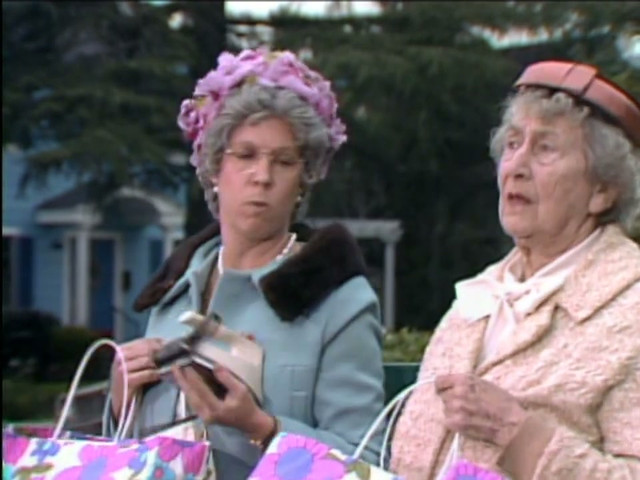
Around them, the shopping district carries its own faded mood. Familiar storefronts and passing strangers create a setting where memory competes with visible decline.
The conversation gradually shifts from old retail standards to present-day street awareness. Mama, energized by her training, assumes the role of an uncompromising security expert.
She tells her companion to stand tall and project strength. Looking uncertain, she insists, can encourage trouble before a single threatening word is spoken.
Her advice contains genuine wisdom, but Mama delivers it with escalating intensity. Every passerby becomes a possible test of her newly recovered courage.
A normal pedestrian can trigger a hard stare. An ordinary movement can become suspicious once Mama filters the street through fear, pride, and fresh classroom instruction.
Her companion is not simply receiving safety advice anymore. She is being coached through an elaborate performance designed to convince the entire neighborhood that they are untouchable.
The comedy comes from Mama’s extreme vigilance. She has moved beyond refusing to look vulnerable and begun acting as though danger is hiding behind every shopping bag.
Yet the performance reveals how deeply the earlier incident still affects her. The bravado is real, but it remains fragile because it was built over unresolved fear.
Mama can lecture about confidence while the threat remains hypothetical. The true test arrives when she recognizes the man connected to the earlier mugging.
In that moment, all her rehearsed toughness appears to vanish. Her posture changes, her certainty falters, and the street suddenly feels less like a classroom exercise.
The difference between controlled practice and an actual confrontation becomes painfully clear. Chuck’s lessons offered structure, while this encounter arrives with memory, pressure, and no predictable sequence.
Mama seems to retreat into the frightened role she worked so hard to escape. Her apparent surrender is startling because it follows such an emphatic campaign of streetwise confidence.
She presents herself as overwhelmed and compliant. Even more surprisingly, she calls attention to her companion’s purse, as though helping the threatening stranger complete his demand.
For a brief stretch, it looks like the training has failed her. The woman who challenged Chuck now appears unable to summon even the defensive posture she preached moments earlier.
However, Mama is repeating the move that worked in class. She is not abandoning the lesson; she is creating the same dangerous comfort that allowed her to surprise Chuck.
Her fear may be genuine, but the surrender is also misdirection. She lets the man believe he understands her before revealing that he has underestimated her again.
The shopping bag now holds more than a disappointing purchase. Inside sits the feather-light iron Mama had dismissed as a symbol of modern decline.
The prop has been planted through casual department-store complaints, making its return feel both ridiculous and inevitable. What seemed like nostalgic banter suddenly becomes part of Mama’s defense.

Using surprise, nerve, and the unlikely appliance, Mama stops the confrontation. The moment avoids turning her into an action hero, preserving the character’s scrappy, improvised comic identity.
Her victory comes from reading the situation rather than overpowering anyone. She understands assumptions, performs helplessness, and chooses the instant when that performance gives her an advantage.
The iron’s light construction, previously treated as a flaw, becomes unexpectedly useful. Mama’s complaint circles back with the precision of a classic sitcom setup and payoff.
She finally concedes that the modern appliance can “do the job after all.” The closing line lands because it resolves the danger, the shopping conversation, and her emotional struggle together. The punchline also allows relief to flood the scene.
Tension breaks, Mama’s personality surges back, and an object she mocked becomes the unlikely emblem of her recovery. What makes the sequence work is the contrast between confidence and fear.
Mama does not simply become fearless after one lesson, because the earlier mugging still has emotional consequences. Instead, she learns to act while frightened.
That distinction gives the comedy an undercurrent of resilience without making the confrontation feel detached from what sent her to class. Chuck’s instruction also receives an unexpectedly thorough payoff.
Finesse matters, confidence matters, but surprise proves decisive in both the classroom demonstration and the street encounter. Mama adapts that principle through performance rather than polished technique.
Her greatest defensive tool is her ability to make others believe exactly what she wants them to believe. First, she convinces Chuck that arthritis has ended their exercise.
Later, she convinces the returning threat that her courage has collapsed completely. Both deceptions exploit assumptions about age and vulnerability.
Mama recognizes those assumptions, resents them, and ultimately uses them as openings instead of accepting them as limitations. The episode never lets her newfound bravado become entirely heroic.
Her exaggerated suspicion of innocent passersby keeps puncturing the image of a perfectly disciplined self-defense student. That imbalance is essential to the humor.
Mama has learned the right lesson, but she applies it with the volume, stubbornness, and theatrical flair that define her. The department-store nostalgia deepens the setup without slowing the story.
Complaints about neighborhood decline and lightweight products create atmosphere while quietly preparing the final visual joke. By the confrontation, every piece is ready.
Mama has fear to overcome, a lesson to remember, a companion to protect, and an iron she considers practically useless. The final twist combines those elements without requiring an elaborate explanation.
One decisive surprise transforms a mundane purchase into the object that restores Mama’s control. Her closing remark is more than a product joke.
It signals that she has reclaimed the quick wit and stubborn authority that the street mugging temporarily disrupted. The victory remains comic because Mama never stops being Mama.
She survives the test through nerve, misdirection, practical timing, and a purchase she was already planning to criticize. The result is a tightly constructed sitcom sequence with an emotional spine.
Fear launches the story, overconfidence complicates it, and improvisation delivers the satisfying final turn. Mama does not leave the street as a disciplined martial artist. She leaves as something more believable and more entertaining: herself, newly alert and armed with one excellent callback.
Để lại một bình luận