A Small-Town Maid Walked Onto The Stage With No Lines, Then Turned A Serious Murder Scene Into Total Chaos.
Every summer, when Hollywood and Broadway stars traveled across America to perform in small-town theaters, the idea sounded charming.
Big names would headline the show.
Local performers would fill the smaller roles.
Audiences would buy tickets because they wanted to see a famous actor in person.
But every once in a while, that “local talent” did not quietly blend into the background.
Sometimes, that local talent became the entire problem.
That is exactly where the trouble begins in this unforgettable Carol Burnett Show sketch.
The scene opens backstage on opening night, where the atmosphere is supposed to feel dramatic, elegant, and professional.
A celebrated actor named Lionel Cromwell is preparing to take the stage in what appears to be a tense mystery play filled with blackmail, murder accusations, hidden proof, and danger.
He expects control.
He expects silence.
He expects the small supporting actors to know their places.
Then Carol Burnett’s character walks in.
She is the local girl hired to play the maid.
Her job is simple.
Hang up a coat.
Mix a drink.
Pour some coffee.
Hand over a newspaper.
Stay quiet.
That is all.
The only problem is that she does not want to stay quiet.
She knows her hometown friends are sitting out in the audience.
She knows this is her big chance to be seen.
And she is painfully aware that her role has no lines.
For a small-town performer standing next to a big star, that is almost a tragedy of its own.
She tries to explain that nobody will notice her if she does not get something to say.
Cromwell, already irritated, makes it clear that this is exactly what he wants.
He does not need personality.
He does not need ambition.
He needs a maid who behaves like furniture.
But Carol’s character is not built to disappear.
She is nervous, eager, awkward, and desperate to turn one silent role into a hometown triumph.
That tiny desire becomes the fuse for the entire disaster.
Once the curtain rises, the play begins as a dark drawing-room thriller.
Cromwell’s character, Hamilton, confronts a man named Denton.
Denton is accused of blackmail.
Hamilton insists that Denton has been taking money from him over a supposed murder.
The stakes are high.
The dialogue is intense.
The audience is meant to feel suspense.
Then the maid enters.
At first, she does what she was told.
She takes a cloak.
But even that simple movement becomes bigger than it should be.
Instead of quietly serving the scene, she makes her presence impossible to ignore.
The more the actors try to continue the dramatic exchange, the more she starts pulling attention away from them.
Hamilton tells Denton that he is not afraid anymore.
He claims he has proof that he did not kill Arnold Grimsby.
Denton is shaken.
The mood is supposed to tighten.
Then the maid appears again, hovering around the action like a one-woman storm.
When Denton asks for a drink, Hamilton orders the maid to make one.
This should be a background action.
Instead, it turns into a full performance.
She does not simply prepare a drink.
She builds a silent comedy routine around it.
Every movement stretches the tension.
Every sound steals focus.
Every glance suggests that she knows exactly how little stage time she has and intends to use every second of it.
The play keeps trying to be a murder mystery.
Carol keeps turning it into a comedy ambush.
Denton gives up on the drink and asks for black coffee.
That should fix things.
It does not.
The coffee service becomes another disaster.
The cup, the sugar, the spoon, the timing, the physical business, and the audience reaction begin to overwhelm the actual plot.
The actors are still talking about murder, memory loss, blackmail checks, and police evidence.
But everyone watching knows the truth.
The maid has hijacked the room.
Hamilton reveals the twist.
Arnold Grimsby is not dead.
According to the morning newspaper, Grimsby survived, suffered memory loss, then regained it after another accident.
That revelation should destroy Denton’s power.
It proves that Hamilton was never a murderer.
It also proves that Denton used a lie to blackmail him.
In a serious play, this would be the turning point.
In this sketch, it is merely another setup for Carol’s chaos.
Hamilton needs the newspaper.
The maid brings it.
But nothing she does happens normally.
She keeps inserting herself into the mechanics of the scene without technically having any lines.
That is the genius of the joke.
She is not breaking the script by speaking.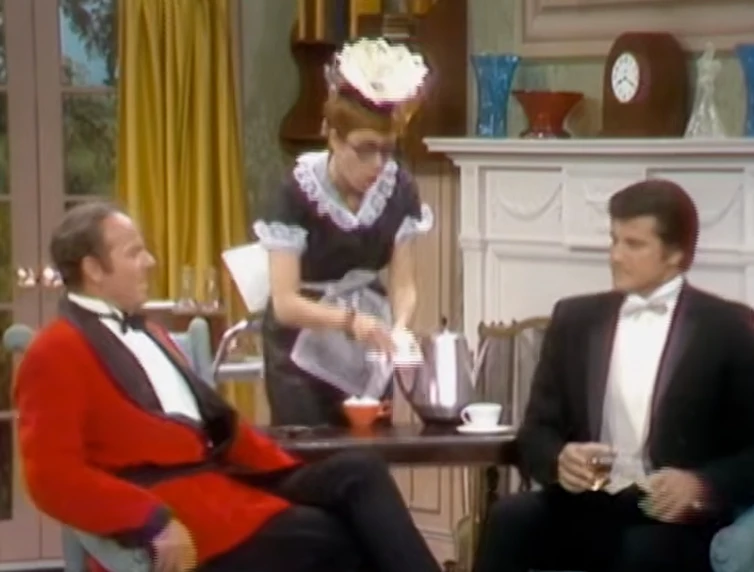
She is breaking it by existing too loudly.
Cromwell’s character tries to regain control.
Hamilton announces that he is calling the police.
He asks the maid for the phone.
This should launch the final confrontation.
Instead, the audience already senses disaster coming.
Denton pulls a gun.
The murder mystery suddenly becomes a life-or-death scene.
He warns Hamilton that he will not live long enough to call anyone.
This is supposed to be Denton’s big dramatic moment.
But even here, Carol’s maid refuses to vanish.
The tension collapses into physical mayhem.
The gun, the actors, the staging, and the maid’s frantic interference collide until the entire “serious” production becomes something completely different from what Lionel Cromwell imagined backstage.
What began as a polished star vehicle becomes a public meltdown.
The famous actor wanted a silent maid.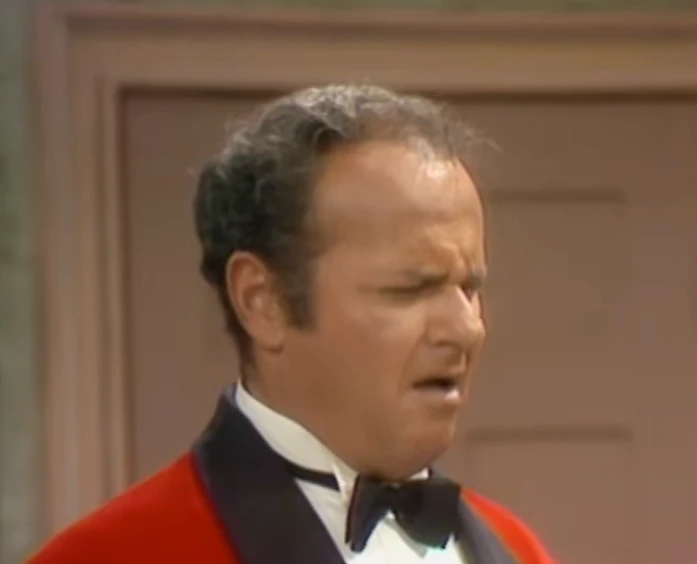
Instead, he got a scene-stealing local performer who turned every prop into a weapon of comedy.
That is why the sketch works so well.
The humor does not come from one punchline.
It comes from watching a fragile theatrical machine slowly fall apart because one person refuses to be invisible.
Carol Burnett’s character is ridiculous, but also strangely relatable.
She has waited for her moment.
She has friends in the crowd.
She has no lines.
And if the script will not give her attention, she will find it in the coat, the drink, the coffee, the newspaper, the spoon, and the phone.
By the end, the murder plot barely matters.
The real mystery is how one maid with nothing to say managed to become the loudest person on stage.
That is classic Carol Burnett comedy.
It starts with a simple premise.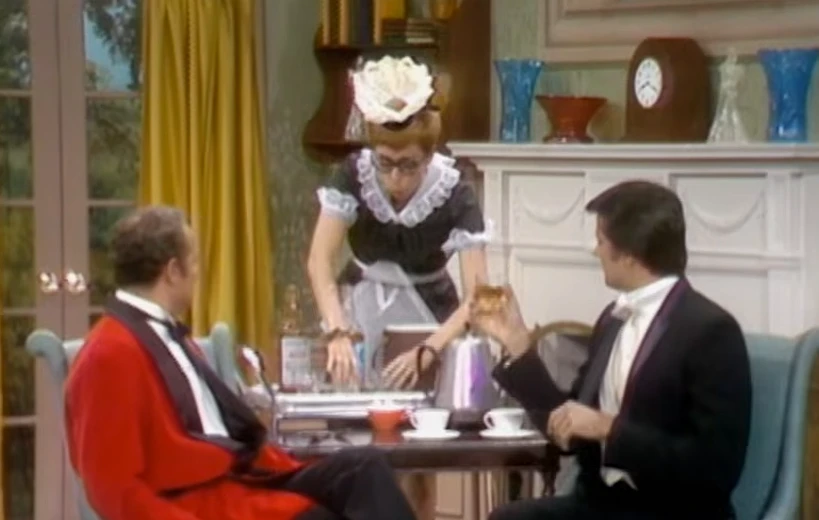
It builds through timing, facial expressions, props, and escalating panic.
Then it explodes into the kind of chaos that makes a live audience lose control.
Lionel Cromwell wanted opening night to belong to him.
But the second Carol walked onstage as the maid, the spotlight quietly changed owners.
And the funniest part is that she did it without ever needing the lines she wanted so badly.
Để lại một bình luận