George And Lenny Kidnap The Wrong Cookie Girl, And The Carol Burnett Show Turns One Crime Plan Into Total Comedy Collapse.
One of the funniest things about The Carol Burnett Show was never just the joke itself.
It was the way a simple sketch could begin with danger, panic, and a terrible plan, then slowly twist into a ridiculous disaster where the criminals became the victims of their own stupidity.
That is exactly what happens in the unforgettable sketch known as George & Lenny Kidnap a Girl Scout.
At first, the setup feels like a classic crime scene.
A nervous man knocks at the door.
Another voice demands a password.
The answer is wrong, confused, and somehow accepted anyway.
Within seconds, the audience understands everything they need to know.
These are not criminal masterminds.
These are two men barely smart enough to open the door to their own hideout.
George is the one trying to act like the brains of the operation.
Lenny is the loyal but hopeless partner who follows instructions without understanding the damage he is causing.
Together, they have planned what they believe will be a perfect kidnapping.
The target is supposed to be the daughter of Peter Desmond, a wealthy banker.
The ransom is supposed to be enormous.
The crime is supposed to change their lives.
But because this is The Carol Burnett Show, the entire plan collapses the moment the bag comes off the victim’s head.
Instead of a terrified heiress, George and Lenny have kidnapped a cheerful young cookie seller from the Fireside Girls of America.
She does not scream.
She does not faint.
She does not beg for mercy.
She simply turns the room into a sales pitch.
With perfect comic innocence, she looks at the two men who abducted her and politely begins offering cookies.
Sandwich cookies.
Vanilla cream.
Every possible kind of sweet treat.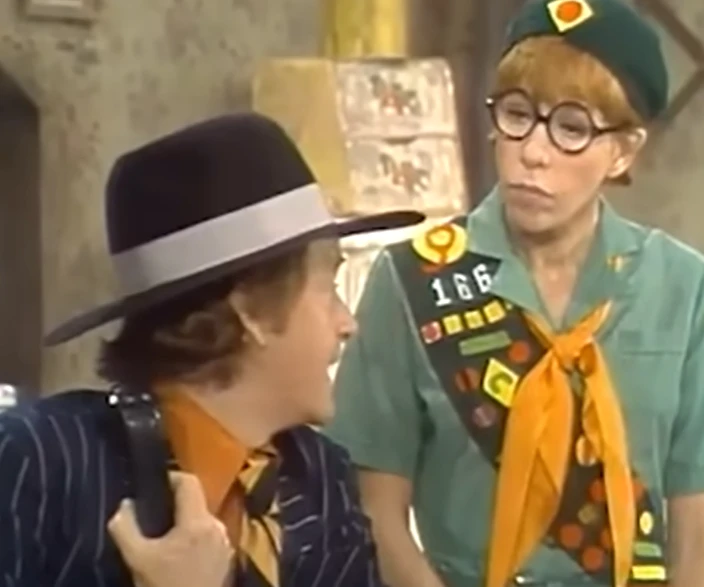
The contrast is what makes the scene explode.
George is trying to run a kidnapping.
The girl is trying to hit her cookie quota.
Lenny is trapped somewhere in the middle, half criminal and half customer.
The first major twist lands when George realizes they have the wrong child.
This is not the banker’s daughter.
Her father is Barney Portoy, a chicken plucker.
In one sentence, the million-dollar ransom dream disappears.
George does not get rich.
Lenny does not get praised.
Their “big crime” has accidentally turned into the worst business decision of their lives.
Still, George refuses to give up.
He decides they might not get a million dollars, but maybe they can still get something.
So he calls the girl’s father, expecting fear, panic, and desperation.
Instead, the sketch delivers one of its sharpest reversals.
The father is not prepared to pay to get his daughter back.
He wants money from the kidnappers to take her back.
The entire power dynamic flips.
George and Lenny thought they had captured a helpless victim.
Now they realize they may have captured a tiny negotiator nobody at home is in a hurry to retrieve.
The girl’s innocence becomes more dangerous than any weapon in the room.
She asks to play games.
Lenny, being Lenny, agrees.
George tries to stay serious, but seriousness has no place in a room this ridiculous.
They try doctor.
That ends badly.
They try cops and robbers.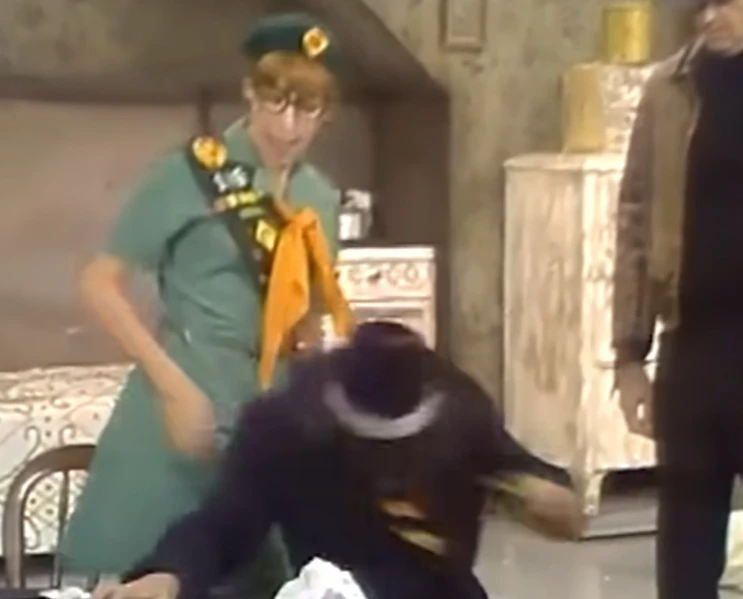
That ends even worse when the girl handles the situation with alarming confidence.
The more George tries to control her, the more she controls the room.
She is not frightened by their threats.
She is not impressed by their plan.
She does not even seem especially bothered by being kidnapped.
Instead, she treats George and Lenny like two difficult recruits for her cookie campaign.
That is where the sketch becomes more than just a silly kidnapping parody.
It becomes a perfect reversal of power.
The men have the hideout.
The men have the phone.
The men have the criminal plan.
But the young cookie seller has something much more powerful.
She has confidence.
She has persistence.
And most terrifying of all, she has a schedule.
By the time George and Lenny try to send her home, it is too late.
She has already figured out the game.
She reminds them that they owe her father money.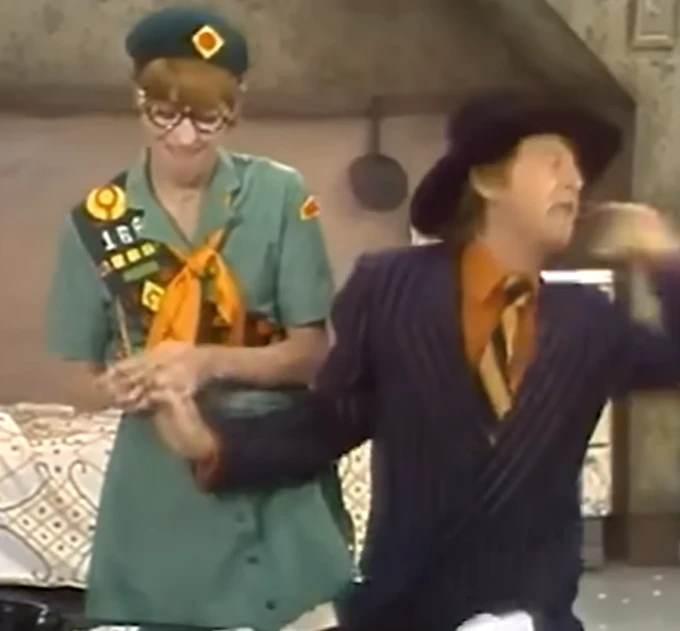
She demands the payment in small unmarked bills.
She warns them that if she walks home alone with that much cash, she might need a policeman to protect her.
And if she talks to a policeman, of course, she can tell him everything about the two kidnappers upstairs.
Suddenly, the criminals are not negotiating ransom anymore.
They are being blackmailed by a cookie seller.
The joke keeps growing because every escape route becomes another trap.
If they keep her, she drives them crazy.
If they let her go, she may send the police.
If they refuse to pay, she stays.
If they try to bargain, she recruits them.
Then comes the final humiliation.
She offers them a way to work off the debt.
Not through crime.
Not through violence.
Not through some dramatic criminal deal.
Through cookie sales.
She imagines George and Lenny as persuasive salesmen who can help her move products door to door.
Actually, they might not even need to knock.
They can break the doors down.
That one idea sums up the whole sketch.
These two men wanted to be feared.
Instead, they are being drafted into youth fundraising.
Then she makes it worse.
There will be flowers.
There will be jams and jellies.
There will be endless cheerful activities.
There will not be a single day when the three of them are not busy together.
That is the moment George and Lenny finally break.
The police, once feared as the enemy, suddenly become salvation.
They would rather be arrested than spend another day under the command of this unstoppable little cookie seller.
The ending works because the sketch never stops escalating.
It begins with a kidnapping.
It becomes a sales pitch.
It turns into a failed ransom call.
It transforms into a hostage negotiation where the hostage wins.
And by the final moment, the kidnappers are begging for law enforcement to rescue them from the person they kidnapped.
That was the brilliance of The Carol Burnett Show.
It could take a dark premise and remove the darkness by making every threat collapse under absurdity.
Nobody in the scene behaves the way a serious crime story demands.
George is too panicked.
Lenny is too clueless.
The girl is too composed.
And the result is a comic machine that keeps flipping expectations until the original plan is completely unrecognizable.
What makes this sketch still so funny is not just the punchlines.
It is the slow realization that George and Lenny were doomed from the start.
They did not kidnap the wrong girl by accident.
They kidnapped the worst possible girl for two weak-minded criminals.
A girl who could sell cookies in a hostage situation.
A girl who could outsmart two grown men without raising her voice.
A girl who turned a ransom plot into a business opportunity.
And by the end, the most shocking part is not that George and Lenny got caught.
It is that they were relieved when someone finally came to take them away.
Để lại một bình luận