The Monkey, the Mayhem, and the Masterclass in Comedy: Tim Conway’s Wild Moment on The Carol Burnett Show
In the golden age of American sketch comedy, few programs reached the level of chaotic brilliance seen on The Carol Burnett Show.
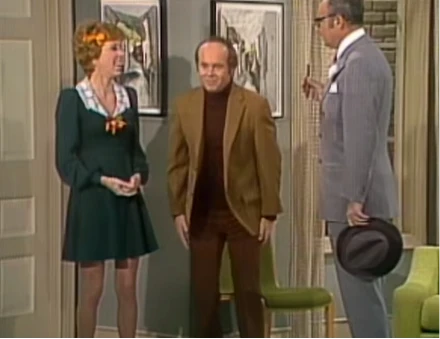
Among its most unforgettable moments are those where everything seemed to spiral out of control—yet in reality, every twitch, stumble, and suppressed laugh was part of a carefully crafted comedic symphony.
One such legendary sketch features Tim Conway, Harvey Korman, and Carol Burnett in a scenario involving a monkey, a cramped apartment, and an escalating sense of absurdity that has since become comedy history.
At first glance, the sketch appears simple: a domestic setting where ordinary characters deal with an unexpected situation involving a monkey.
But as with many of Conway’s performances, simplicity is only the surface.
Beneath it lies a slow-burning improvisational explosion designed to test the composure of everyone on stage—especially Harvey Korman, who became both the straight man and the primary victim of Conway’s unpredictable genius.
From the moment the scene begins, something feels slightly off. The apartment set, already tight and cluttered, becomes a pressure cooker for physical comedy.
Carol Burnett’s character attempts to maintain order, but there’s an unspoken sense that order is already gone.
The monkey—innocent in appearance but chaotic in effect—serves as the catalyst for everything that follows.
Then Tim Conway enters.
What happens next is not just acting, but controlled disruption. Conway moves with an odd, exaggerated energy that immediately signals trouble.
His timing is slow, deliberate, and almost hypnotic.
Every pause feels like it might be the end of the joke—but instead, it’s just the setup for something worse (or better, depending on your tolerance for comedic collapse).
The monkey bite is the turning point. It’s small, almost insignificant in isolation, but Conway treats it like a life-altering event.
Suddenly, his character begins to behave strangely—too strangely. His movements become erratic.
His expressions shift from calm confusion to exaggerated panic. And then comes the transformation: Conway starts behaving as if he himself is becoming part of the animal chaos in the room.
This is where the sketch transcends typical sitcom comedy.
Harvey Korman, ever the professional, tries desperately to remain composed.
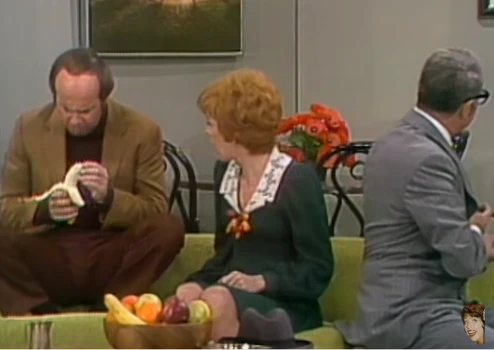
His role requires him to react logically, to ground the scene in reality.
But Conway’s unpredictability makes that nearly impossible. Korman’s facial expressions begin to crack. His eyes dart.
May you like

His mouth tightens into a battle between professionalism and laughter.
The audience can feel the pressure building in him like steam in a locked kettle.
Meanwhile, Carol Burnett becomes the embodiment of exhausted authority.
She attempts to steer the scene back into order, but every attempt is undermined by the escalating absurdity.
Her reactions—half frustration, half disbelief—anchor the audience’s sense that this situation has gone far beyond repair.
Conway, however, is fully committed to the descent.
His performance after the “bite” is what fans still talk about decades later. He doesn’t just act strange—he escalates strange into something almost animalistic, as if the jungle has been invited directly into the apartment.
He hops, he darts, he shrieks in exaggerated bursts, and yet somehow maintains a straight face that makes the entire thing even more unsettlingly funny.
It is as if he is daring the others not to break.
And they do break—just not all at once.
Korman is often the first casualty of Conway’s comedic warfare.
There is a moment, subtle but devastating, where Korman’s composure begins to collapse.
His attempt to continue the dialogue becomes strained.
A smile creeps in, uninvited, betraying everything his character is supposed to maintain.
That smirk becomes the signal to the audience: the scene is now officially out of control.
Burnett, watching the chaos unfold, reacts like someone witnessing a controlled explosion that is no longer controlled.
Her character’s frustration mirrors the real-life challenge of performing opposite Conway—never knowing whether the next second will bring dialogue or disaster.
The brilliance of the sketch lies not in the premise itself, but in the performers’ willingness to surrender to it.
Conway, in particular, mastered the art of pushing his co-stars to the edge without ever fully breaking character himself.
He weaponized timing, silence, and unexpected physical choices to destabilize every scene he entered.
What makes this monkey sketch endure is not just the humor, but the layered performance beneath it.
It is improvisation disguised as structure, chaos disguised as control. Every reaction from Korman and Burnett is both character-driven and real, blurring the line between scripted television and genuine human response.
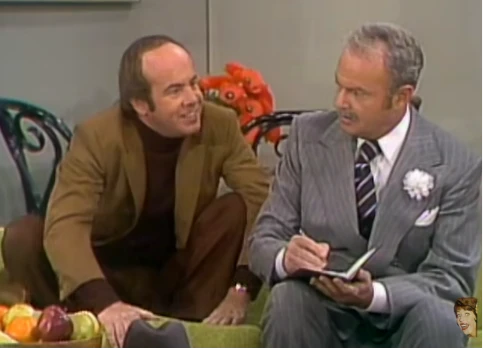
By the end of the sketch, nothing in the apartment resembles order.
The monkey is no longer the only source of chaos—Conway has fully taken that role.
The energy in the room feels uncontainable, as though the set itself might collapse under the weight of laughter.
And yet, the final image is not one of destruction, but of joy.
The performers are laughing, the audience is laughing, and even the attempt to maintain seriousness has become part of the joke.
It is a reminder of why Tim Conway remains one of the most celebrated figures in sketch comedy history.
His ability to disrupt a scene while elevating it, to push his co-stars into genuine reactions while staying locked into character himself, is a skill that few have ever matched.
In the end, the monkey may have started the chaos—but it was Conway who turned it into comedy legend.
Để lại một bình luận