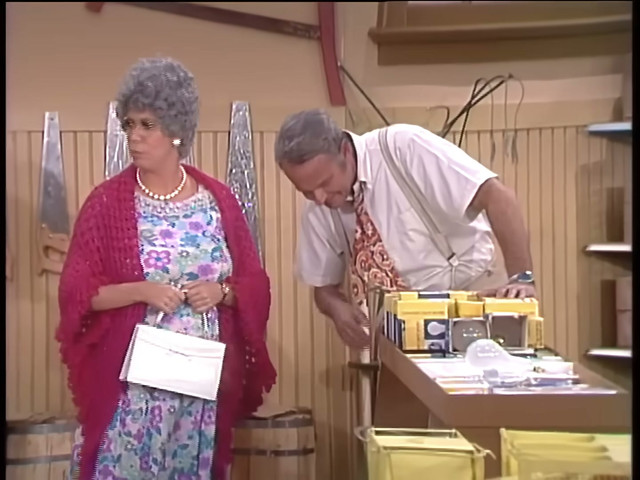
The counter at Central Hardware looks ordinary enough at first, almost stubbornly ordinary. A customer stands nearby, business continues, and the man behind the counter keeps the day moving with practiced retail cheer.
That calm is the first joke, because The Family never enters a room without changing its weather. In this sketch from The Carol Burnett Show, a simple store visit becomes a domestic storm with a cash register.
The scene opens with the store operating as a workplace, not a family battleground. Tools, odd supplies, and familiar shelves create the feeling of a small local business trying to survive one transaction at a time.
The proprietor jokes with a customer, leaning into the easy rhythm of someone who knows his trade. He is alert, performative, and just polished enough to seem professional before the family arrives.
Then the door opens on a surprise that is meant to delight him. Instead, it lands like a warning bell.
His wife appears first, arriving with a playful disguise-style flourish and a bright sense of occasion. She and her mother have stopped in while heading to the movies, expecting the visit to feel charming.
That expectation lasts only moments. The minute the older woman enters, the air shifts from surprise party to interrogation.
The daughter wants lunch, attention, and proof that the stop was worth making. Her husband wants to keep the store open, protect the business, and avoid another public family scene.
The mother wants a bathtub drain stopper. In this family, even that small errand carries enough grievance to fill an aisle.
What makes the sketch sing is how quickly everything ordinary becomes personal. A hardware store is not just a hardware store once these three begin circling one another.
A lunch invitation becomes a loyalty test. A missing employee becomes evidence of poor judgment.
A drain stopper becomes a platform for complaint, criticism, and perfectly timed disbelief. The wife pushes for a quick outing, insisting he leave the counter and take them to lunch.
He resists because the store cannot be abandoned, especially with his employee away on an errand. That absent employee, Mickey Hart, hovers over the sketch before he even returns.
His name becomes another combustible object placed on the counter. The husband explains that Mickey is not there, and an important business call could come in.
It is the kind of reasonable excuse that stands no chance against this family. The wife hears delay, disappointment, and rejection all at once.
Her face and voice sharpen as the planned treat turns into another familiar letdown. The mother hears something else entirely.
She hears an opening to mock the whole operation. She questions the store, the errand, the inventory, and the judgment behind it all.
Her blunt commentary cuts through the scene with the casual force of someone who never softens a punchline. The daughter tries to control the visit, but control is impossible with her mother beside her.
Every correction triggers another dispute, and every dispute exposes old resentments. They argue over small details, including the movie plan and the reason for stopping by.
The comedy grows from how enormous these tiny disagreements feel inside the Harper family orbit. Nothing is ever only about the present moment.
Each line carries the weight of years spent needling, defending, and bracing for the next insult. The husband attempts to keep one foot in commerce and one foot in marriage.
That split becomes funnier the harder he tries to maintain it. A customer may appear, a phone may matter, and the counter may need tending.
Yet his family treats the store like their private living room with better lighting. The older woman’s search for a drain stopper sends the action into the aisles.
Suddenly, the merchandise itself becomes the target of the sketch. She spots items that strike her as ridiculous and says so with lethal simplicity.
Purple light bulbs and butterfly nets become exhibits in a trial of retail absurdity. The husband defends the inventory because he must defend himself.
If he bought it, he insists, he can sell it. That boast is pure sitcom desperation, and Harvey Korman plays the strain beautifully.

His character needs the store to look respectable, even while his relatives dismantle that respect shelf by shelf. The wife’s frustration builds as her mother keeps wandering and commenting.
Lunch slips further away, and the cheerful surprise hardens into a public humiliation. Carol Burnett gives the wife that unmistakable combination of wound and fury.
She does not merely become angry; she becomes visibly betrayed by inconvenience. Her disappointment is comic because it is so grandly disproportionate.
Yet it remains recognizable, rooted in the everyday sting of not being chosen first. Vicki Lawrence’s mother is equally exacting, but in a different key.
She does not strain for approval because she assumes her verdicts are final. She can turn a product display into a character assessment.
She can make a bathtub drain stopper sound like an indictment. The sketch understands that some families do not need big events to explode.
They only need time, proximity, and one person insisting they are perfectly calm. The hardware store setting sharpens the tension because it demands ordinary behavior.
This is a place for customers, sales, and professional smiles. Instead, it becomes a stage for exposed nerves.
The contrast between public space and private grievance gives every exchange an added snap. The husband’s job is to keep things running, but his family keeps pulling him into emotional traffic.
He cannot complete a simple explanation without being interrupted, challenged, or ridiculed. The wife arrives hoping to interrupt his day affectionately.
When he refuses to drop everything, that affection curdles into accusation. The mother arrives with a practical need, or at least that is her claim.
Soon, the errand becomes a guided tour through everything she finds foolish. Even the absent Mickey becomes part of the machinery.
Tim Conway’s character is set up as a wildcard before he enters the action. The others speak of him with enough skepticism to make his return feel loaded.
His absence gives the husband a reason to stay and the family another reason to complain. That is classic Family construction.
One problem creates another, then another, until nobody can remember how the first problem began. The audience laughter builds because the rhythm is both heightened and painfully exact.
These characters know exactly where to press, and they press without mercy. The wife’s needling is not random; it is full of history.
The mother’s complaints are not just jokes; they are weapons polished by repetition. The husband’s defensiveness reveals how often he has been placed in this position.
He is not surprised by the attack, only tired of performing through it. The store’s strange stock gives the sketch a parade of physical triggers.
Every odd item offers a new opportunity for disbelief. Purple light bulbs are not just purple light bulbs here.
They become proof, in the mother’s eyes, that the storekeeper has questionable priorities. Butterfly nets are not simply merchandise.
They become another chance to puncture his confidence while he tries to look like a man of business. The writing lets the objects remain mundane while the reactions grow theatrical.
That balance keeps the scene lively instead of chaotic. The audience recognizes the escalation pattern immediately.
First comes the surprise, then the awkward excuse, then the insult dressed as practical observation. After that, everyone digs in.
Nobody leaves, nobody lets go, and nobody allows a moment to pass without commentary. The wife keeps returning to the emotional meaning of the failed lunch plan.
She wanted him to step out of his routine and choose the outing. He keeps returning to the logistics of running a store.
He cannot close, cannot miss the call, and cannot pretend Mickey’s absence does not matter. The mother keeps returning to the stopper and to whatever irritation crosses her path.

Her mission appears simple, yet she turns it into performance art. The brilliance lies in how all three are partly right.
The wife did make an effort, the husband does have responsibilities, and the mother does need her item. The disaster comes from their complete inability to grant one another the smallest grace.
Every explanation is treated as an attack, and every attack demands a louder reply. That emotional architecture made The Family sketches enduring.
Beneath the bickering, there is a recognizable ache. The characters are not strangers clashing over nothing.
They are relatives trapped in patterns so familiar that each can predict the next injury. The hardware store simply gives those patterns a fresh arena.
Instead of a kitchen table, they have a counter, shelves, stock, and customers watching the pressure rise. The setting also allows the husband to be judged in his own domain.
That detail makes the visit more invasive and more comic. He is not failing at home in this moment.
He is being undercut at work, in front of the very world he is trying to manage. The wife’s embarrassment feeds her anger because the scene keeps slipping beyond her control.
She wanted a surprise, but she brought the storm with her. The mother seems almost energized by the store’s opportunities.
Each shelf offers evidence, each item offers a punchline, and each response invites another jab. The performers trust the pauses as much as the lines.
A look, a delay, or a wounded intake of breath can draw as much laughter as the joke itself. That is especially true when the husband tries to defend the indefensible.
His insistence that every strange purchase can become a sale is both ridiculous and oddly noble. He believes in his stock because he has to believe in something.
In this scene, even a butterfly net becomes a matter of dignity. The sketch’s anticipation around Mickey Hart adds another layer of comic suspense.
The audience is told enough to expect trouble once he reappears. His absence already causes problems, which makes his eventual presence feel like a promise.
The scene builds him as one more unpredictable force in an already unstable room. By the time the family moves through the aisles, the surprise visit has fully collapsed.
What began as a bright interruption becomes an exhausting contest of wills. The store never stops being a store, which is part of the fun.
Business still matters, the phone might ring, and customers remain a possibility. But the family drama overwhelms everything.
No aisle marker or counter bell can compete with people this committed to being aggrieved. The Carol Burnett Show thrived on turning recognizable frustration into theatrical release.
This sketch does exactly that, using retail routine as kindling for family combustion. There is no need for a grand plot twist.
The twist is that everyone behaves exactly as expected, and it still feels explosive. A lunch plan, a movie outing, and a stopper errand should not create this much pressure.
In The Family’s hands, they become a full comic siege. The humor never depends on cruelty for its own sake.
It comes from timing, character, and the painful accuracy of people who know each other too well. The wife’s hurt keeps colliding with the husband’s responsibility.
The mother’s certainty keeps cutting through both of them. That triangle gives the sketch its engine.
Every time one side tries to stabilize the room, another side yanks it off balance. The result is a hardware store scene that feels larger than its setting.
The aisles become emotional trenches, and the counter becomes a witness stand. Central Hardware starts the sketch as a place of commerce.
It ends as another unforgettable battlefield in the Harper family’s ongoing war of words. For viewers, that transformation is the pleasure. The smallest errand becomes high drama, and the most ordinary workday becomes impossible to forget.
Để lại một bình luận