The Carol Burnett Show built its reputation on taking the simplest comedy idea and pushing it until the audience could barely breathe.
In the sketch titled Carol Can See Into The Future, the show delivers exactly that kind of controlled chaos.
At first, the setup looks like a familiar debate between reason and mystery.
One man believes psychic phenomena may be real.
Another dismisses it instantly as nonsense, rubbish, and nothing more than dramatic imagination.
But then Myra Hingleman enters the room.
From the moment she appears, the entire energy of the sketch changes.
She is not loud in a threatening way.
She is not mystical in the traditional sense.
She is simply exhausted by knowing too much.
That is where the comedy begins.
Myra claims she can see what is going to happen before anyone else does.
To everyone around her, that sounds impossible.
To her, it is a curse.
She is miserable because every ordinary moment has already happened in her mind.
Every sneeze.
Every phone call.
Every accident.
Every embarrassing secret.
The skeptical doctor wants proof.
He does not want vague predictions or dramatic speeches.
He wants to see something happen with his own eyes and hear something confirmed with his own ears.
That is the perfect trap.
Because in classic Carol Burnett fashion, the more aggressively someone refuses to believe, the more ridiculous the evidence becomes.
Myra does not begin with some giant prophecy.
She starts with something small, personal, and impossible to explain.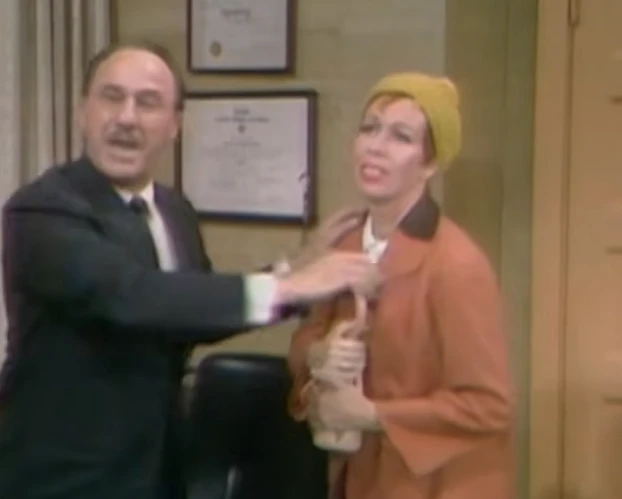
She notices details she should not know.
She reacts before things happen.
She predicts the kind of everyday accidents nobody could fake without turning the room into a disaster zone.
The comedy grows because everyone else is always one second behind her.
The audience knows something is coming.
The characters do not.
That tiny gap becomes the engine of the entire sketch.
One of the funniest moments comes when Myra anticipates a sneeze before it happens.
A sneeze is nothing dramatic by itself.
But when someone predicts it with total confidence, it suddenly becomes proof.
The skeptical doctor still resists.
He keeps insisting that none of this means anything.
But his confidence begins to wobble.
Then the phone rings.
Myra already knows what the call will be.
It is a wrong number.
Even better, it is the kind of wrong number that makes the whole room feel more ridiculous.
The call is not important.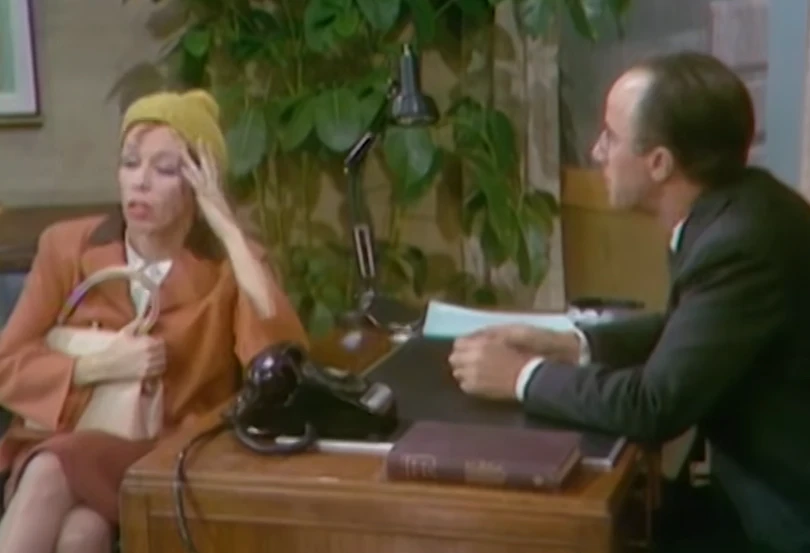
That is what makes it funny.
A fake psychic sketch might normally build toward life-and-death predictions.
This one uses a simple mistaken call to make the skeptic look increasingly helpless.
Each ordinary event becomes a comic explosion.
Then comes the pen.
Someone tries to take notes, as if science can still control the situation.
Myra casually warns that a new pen may be needed.
Moments later, the ink disaster proves her right again.
Even the cleanup advice becomes part of the joke.
The future is not arriving through thunder and lightning.
It is arriving through stains, sneezes, wrong numbers, and rising embarrassment.
That is why the sketch works so well.
It turns psychic power into domestic inconvenience.
Then the writing takes a sharper comic turn.
Myra reveals that she has warned famous people before.
She mentions Elizabeth Taylor and her marriages across multiple years.
The joke lands because it takes a real-world celebrity reference and folds it into Myra’s impossible burden.
She does not present herself as powerful.
She presents herself as someone nobody listens to.
That makes her prediction gift both hilarious and strangely tragic.
Imagine seeing every mistake before it happens and still being unable to stop anyone.
That absurd frustration is pure Carol Burnett-style comedy.
The skeptic, however, still does not fully surrender.
He wants more research.
He wants Myra to come to his laboratory.
He thinks he can study her.
That is when the sketch turns from funny to completely unhinged.
Myra calmly explains that she cannot come next week.
She will be on her honeymoon.
The doctor asks the natural question.
Who is the lucky man.
The answer lands like a comedy bomb.
She says it is him.
Suddenly, the man who demanded proof gets more proof than he ever wanted.
He is not just observing the future anymore.
He is trapped inside it.
The room shifts instantly from curiosity to panic.
The doctor reacts as though the prediction itself has physically attacked him.
Then Myra pushes the joke even further.
She reveals that their future apparently includes triplets.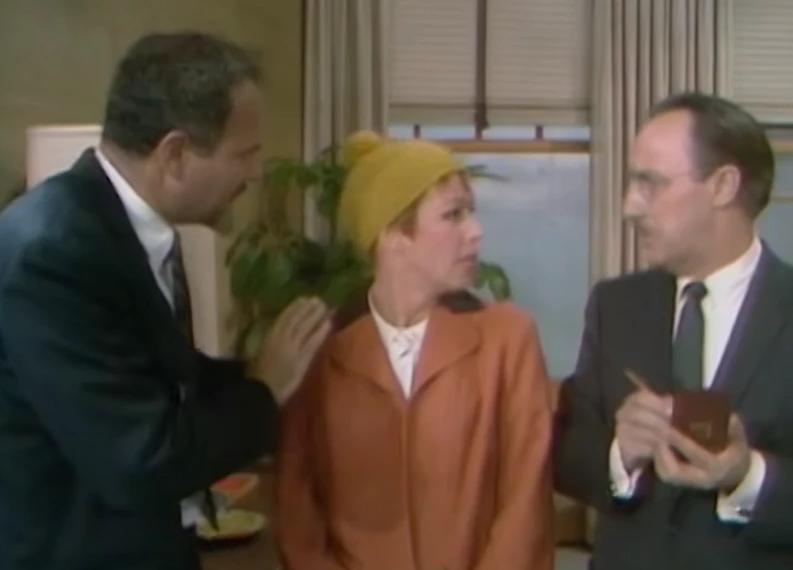
Not just any triplets.
The names are Hans, Fritz, and Adolf.
The absurdity is so extreme that it becomes impossible for the skeptic to maintain dignity.
The man who mocked psychic ability is now being told about a marriage, children, and a hospital scene before he has even agreed to anything.
The future has stopped being an idea.
It has become a punchline chasing him across the room.
The final escalation turns the entire sketch into classic physical comedy.
There is talk of an ambulance.
There is panic.
There is the suggestion of an accident ward.
There is even a convertible involved.
Everything Myra says feels like it is dragging the characters toward some ridiculous destiny they cannot outrun.
That is the brilliance of the sketch.
The joke is not simply that Myra can predict the future.
The joke is that nobody is emotionally prepared for how specific the future is.
The more detailed she becomes, the funnier it gets.
Carol Burnett’s genius was always in making absurd situations feel completely alive.
She could take a wild premise and ground it in human reactions.
The panic feels real.
The disbelief feels real.
The timing feels dangerous in the best possible way.
Every pause matters.
Every reaction feeds the next laugh.
Every prediction raises the stakes without ever losing the silliness.
Carol Can See Into The Future is not just a sketch about ESP.
It is a sketch about control.
The skeptical doctor wants to control the room.
Science wants to control the mystery.
Conversation wants to control the chaos.
But Myra already knows where everything is going.
That makes her the calmest person in the room and the most terrifying.
By the end, the audience is not watching a debate about psychic powers.
They are watching one man slowly realize that the joke may already be written, the ending may already be waiting, and the only thing he can do is fall directly into it.
That is why this classic moment still works.
It is fast.
It is strange.
It is theatrical.
It is packed with escalating surprises.
And above all, it proves that on The Carol Burnett Show, even the future was not safe from becoming a
Để lại một bình luận